
AEO vs GEO in 2026: A Simple Guide for Small Business Owners
Leave a Comment / By mufsidigital / november 6 , 2026
Picture a restaurant owner in Kozhikode whose Google ranking looks healthy, yet the phone has gone quiet. The reason is that his hungry customers are now typing “best biryani near me” into an AI chatbot and trusting the first few names it gives. His restaurant is not among them. As a performance marketer in Calicut, I see this pattern more and more. Two terms explain it: AEO and GEO. This guide explains both in plain words and shows what you can do about them this month.
1. AEO in One Minute ?
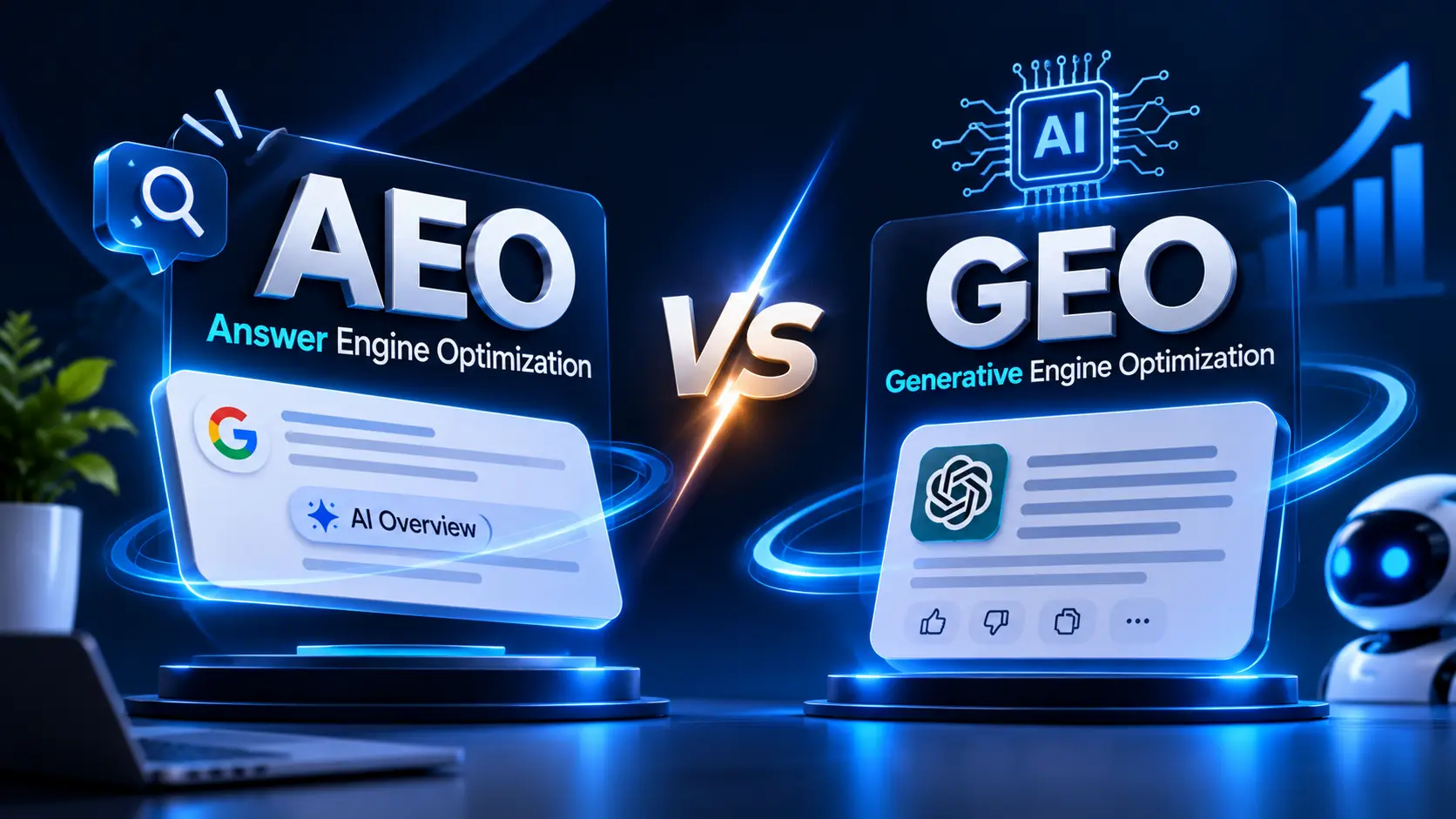
AEO stands for Answer Engine Optimization. It is the practice of shaping your pages so that a search engine can lift a ready-made answer straight out of them. That answer might appear as a highlighted box above the results, inside a “People Also Ask” dropdown, or as a voice reply from a phone assistant.
The trick is to behave like a good teacher. State the answer in a line or two, then explain it. Engines reward pages that respond quickly and clearly.
2. GEO in One Minute ?
GEO stands for Generative Engine Optimization. Here the audience is an AI system such as ChatGPT, Gemini, Perplexity or Google’s AI Overviews. These tools do not hand over ten links. They compose a reply from material they consider reliable, and they sometimes name the sources.
GEO is the work of becoming one of those sources. You earn that place by being easy to understand, consistently described across the web, and backed by real proof.
3. AEO vs GEO: Where They Differ?
Think of AEO as winning the spotlight on a search page, and GEO as winning a mention inside a written AI response.
- Where it happens: AEO plays out on search result pages and voice devices. GEO plays out inside chat-style AI answers.
- What you want: AEO wants your text shown as the answer. GEO wants your brand named or linked.
- What works best: AEO loves tight, direct replies. GEO loves substance: experience, examples and facts that are yours alone.
- How you measure it: AEO shows up as snippets and voice answers. GEO shows up as brand mentions when you test AI tools yourself.
Neither replaces the other, and neither works without a healthy base of ordinary SEO.
4. Why 2026 Is the Year to Pay Attention
Buying journeys are getting shorter. A customer asks one question, receives one summary, and often decides without visiting any site. For local services, that summary may contain only two or three businesses.
This actually favours small, focused companies. AI systems are not impressed by size. They look for pages that are specific, honest and consistent. A neighbourhood clinic that explains its treatments clearly can outrank a national chain that publishes generic text.
5. A Practical AEO Checklist?
- Turn your page headings into the questions customers genuinely ask, such as “How much does a website cost in Kerala?”
- Place the answer directly under the heading, in no more than three lines.
- Add a short FAQ block and mark it up with FAQ schema.
- Write in everyday language. If a sentence sounds awkward when read aloud, rewrite it.
- Keep your Google Business Profile complete, with accurate hours, services and photos, because local voice searches lean on it.
6. A Practical GEO Checklist
- Prove who you are. Show the author’s name, background and past results on every important page.
- Publish what only you know. A small study of your own campaigns or customers gives AI tools something worth quoting.
- Be consistent everywhere. Use the same business name, address and description on your website, directories and social profiles.
- Earn outside mentions. Local news sites, industry blogs and review platforms all strengthen trust.
- Format for scanning. Short sections, clear subheadings and simple tables help machines pick out facts.
- Refresh regularly. Revisit older articles and update figures, dates and examples.
7. Mistakes That Quietly Cost You Visibility
- Writing for algorithms instead of people. Repeating a keyword unnaturally helps nobody.
- Burying the answer. If the reader scrolls past three paragraphs of warm-up, so does the engine.
- Neglecting reviews. Recent, genuine feedback tells both Google and AI tools that you are active and trusted.
- Treating content as a one-time job. Stale pages slowly disappear from view.
- Forgetting the technical side. Slow, clumsy mobile pages undermine even the best writing.
8. Conclusion
SEO still matters, but on its own it no longer covers how people find businesses. AEO puts your answers in front of searchers, while GEO gets AI tools to speak your name. The first steps are modest: tidy your key pages, answer real customer questions, build a consistent presence online, and keep updating.
If you would like a partner to turn this into enquiries and sales, a performance marketer in Calicut who understands both ads and AI-ready content can shorten the learning curve. That is exactly what we do at Mufsi Digital: data-driven campaigns supported by content that search engines and AI tools can trust.